
Zürich
Kirche Wollishofen
Building data
Denomination | Evangelical Reformed
Building type | Church
Year of construction | 1935 – 1936
Architect | Henauer, Walter; Witschi, Ernst
Town, canton | Zürich, ZH
Street address | Auf der Egg 11
GPS | 47.34179, 8.53259
Google Maps | Swisstopo
Reuse
Year of reuse | 2015/2023
Ownership | Unchanged
Building interventions | Unchanged
Form of use | Shared use
Type of use | Miscellaneous
Brief information | Following a competition, the ‘Kunst Klang Kirche’ project began a pilot phase in 2015, which ran until 2018, when it came to an end. Since 2023, the venue has been used by the artists’ collective Projektil. It also continues to be used for religious purposes.
Further information | see below
Status of information
Entry created | 2015/08
Entry last updated | 2024/02




Further information
The new Reformed Church in Zurich-Wollishofen is set to become the “KunstKlangKirche” in future: an open organ centre dedicated to music, culture, encounters, research and teaching, but where religious services can nevertheless continue to be held.
Location
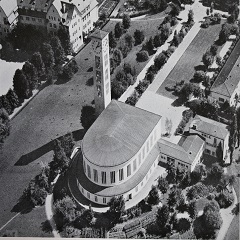
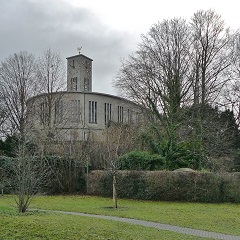
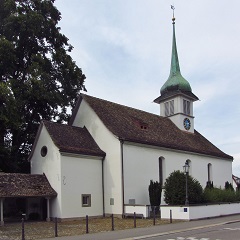
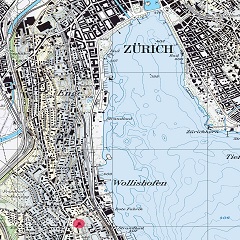
The church is situated high up on the Egg moraine ridge, which runs parallel to the lake, and is visible from afar. The site is bounded by Kilchbergstrasse, Albisstrasse and Kalchbühlstrasse. Two winding paths lead visitors from Kilchbergstrasse to the church, first climbing up and then skirting around it to reach the main entrance. On the other side, the main entrance to the church is accessible via the Eggweg. With the curve of its nave, the church follows the curve of the moraine ridge towards Zurich.
Church
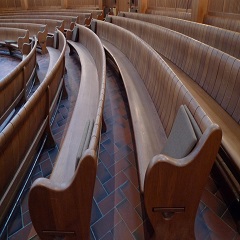
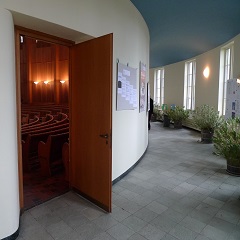
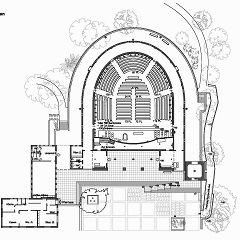
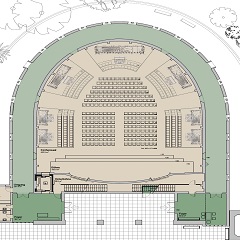
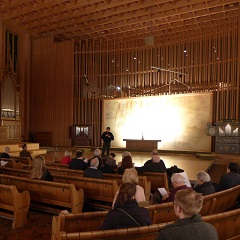
The new Reformed church in Wollishofen was designed as part of a design competition organised in 1930 and a competition to solicit designs for a church with a vicarage and accommodation for a nurse, held in 1931. The building project comprised the church, a vicarage and terraced houses (Auf der Egg 1–7). The church was built in 1935–1936 by the architects Walter Henauer and Ernst Witschi. The Egg Church is one of Zurich’s earliest religious buildings constructed from reinforced concrete and a major example of the ‘Neues Bauen’ (New Architecture) movement in the city. The reinforced concrete structure was clad with shell limestone slabs. Two galleries surround the semi-circular nave: an outer, open gallery and an inner, enclosed gallery, which provides access to the interior. Visitors are guided to the gallery, either to the right or left, through the three-square openings in the south vestibule, on the outer face of the pulpit wall. They enter the nave from the side or from the rear. The outer pews have been adapted to follow the curve, whilst the inner pews face front. The interior has been panelled with light-stained fir. The walls are punctuated by supporting pillars, between which rectangular triple-paned windows can be seen, flooding the space with light. In front of the pulpit wall and the gallery stand the Lord’s Supper table and the pulpit. Part of the wall has been fitted with a wooden lattice, behind which the organ is situated.
Repurposing projects
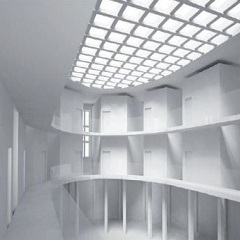
The Reformed parish of Wollishofen has two churches. Increasingly, services are held in the smaller of the two, the old church, situated at the foot of the hill on which the new church stands. On 24 June 2012, to mark the 75th anniversary of the ‘Auf der Egg’ church, the Wollishofen parish launched a design competition for the repurposing of the church. From the 58 entries submitted, the jury selected three winning proposals. The first winning proposal, ‘Holy Spirit’, submitted by Isabelle Meier, proposed using the church as a family hotel. Twenty-five hotel rooms the hotel would have been fitted out in the nave, on two levels, running alongside the windows. In the centre of the space, on the ground floor, a café would have been created, whilst a covered play area would have been set up in the surrounding areas. This would have been Zurich’s first family hotel. The second winning project, ‘WollisHof’, submitted by Regina Schibli and Katja Weber, aimed aimed to bring together gastronomy, art, culture and science to create a meeting place. The aim was to create a meeting place for the neighbourhood, conducive to interaction, where knowledge would be shared and community life would be promoted. In spring 2014, the parish decided to implement the third winning project, ‘KunstKlangKirche’, presented by Beat Schäfer.
Project ‘KunstKlangKirche’
The ‘KunstKlangKirche’ project uses the church as a centre dedicated to the organ by installing, within this space with its excellent acoustics, a selection of organs in various styles. The ‘KunstKlangKirche’ is set to host a mix of liturgical, artistic, educational and research activities centred on the organ. Public events such as concerts, exhibitions and workshops will be organised there. At the same time, the focus on the organ opens new avenues for research and teaching. In addition to organ music and choral music, other art forms, such as dance, are also a key focus. The church will continue to be used for religious services. The planned architectural modifications are as follows: achieving greater flexibility of use (seating arrangements); enhancing the spatial effect through brighter and more variable lighting; constructing organ platforms along the walls of the oval to house the instruments; converting the gallery for various events; and adapting the infrastructure.
Progress status
The ‘KunstKlangKirche’ project is in its pilot phase from 1 July 2015 to the end of 2017. In September 2014, the City of Zurich decided to merge the Zurich parishes into a single overarching parish with effect from 1 January 2019. The City’s Association of Municipalities therefore does not wish to make any new investments between now and the end of 2017, including for the costly renovation of the new Reformed church in Wollishofen. A foundation has declared itself willing to co-fund the ‘KunstKlangKirche’ project. Subsequently, other foundations also decided to contribute to the funding. The implementation of the plans has therefore not been halted, but is proceeding in stages as sub-projects, depending on the financial resources available. The programme began on 1 January 2016. The association ‘Freundeskreis KunstKlangKirche Zürich’ supports the project.
In August 2018, the ‘KunstKlangKirche’ project was definitively abandoned due to financial difficulties. The Auf der Egg church is often used for musical rehearsals because of its distinctive acoustics. Various religious groups, such as the Eritrean Orthodox Church, have the right to use the church to hold religious services. From 2023 to March 2024, the parish has sublet the church on a trial basis to the artist collective Projektil, which will present its light shows there from late September 2023. Interactive projections and a painting workshop are planned in the corridor surrounding the nave. To enable the projections to take place in the nave during the day, automatic blinds have been installed. A long-term lease is planned.
Testimonials
- Matthias Hubacher, head of public works at the Association of Zurich Municipalities, on the outcome of the competition: he is delighted that Wollishofen is looking to the future with hope. “Repurposing expanded uses and temporary uses of churches are objectively sensible, but they are a delicate matter, as churches are very special buildings that symbolise lofty values”. However, three respectful proposals have been put forward here. Self-financing is important, as the upfront investments required for repurposing are not feasible for the municipal association given its financial situation.
- “If the local council and the central parish council, the cantonal churches, the city, the canton, the University of Zurich and Zurich University of the Arts, as well as private individuals, recognise a common interest in this project, the implementation of the ‘KunstKlangKirche’ concept will be a success.” (Description of the KunstKlangKirche Zurich project)
- “Through its activities, the KunstKlangKirche Zurich strives to provide meaning, convinced that the union of art and religion is a source of particularly expressive, stimulating, comforting and uplifting power. To this end, it draws on quality, diversity, innovation and commitment.” (Description of the KunstKlangKirche Zurich project)